Tokenization Pathways: Protecting Recurring Payments in Terminal Networks and Digital Gateways
Rafael Otto · Aug 1, 2026
Tokenization Pathways: Protecting Recurring Payments in Terminal Networks and Digital Gateways
Tokenization replaces sensitive payment card data with unique identifiers that hold no intrinsic value, and this approach has gained traction across both physical point-of-sale environments and web-based gateways that handle recurring revenue streams. Observers note that the method limits exposure during authorization flows while supporting seamless repeat billing cycles for merchants who rely on subscription models.
Core Mechanics Behind Tokenization in Payment Flows
Researchers describe tokenization as a process where primary account numbers convert into tokens through cryptographic algorithms, and these tokens then travel through processing networks instead of actual card details. Data shows that this substitution occurs at the point of capture, whether on a countertop terminal or during an online checkout sequence, and it maintains compatibility with existing authorization protocols. Studies from industry reports indicate that tokens can be single-use or persistent, with the latter proving especially useful for recurring charges because they allow repeated deductions without re-entering card information each cycle.
According to guidelines from the PCI Security Standards Council, tokenization must align with established security requirements that govern storage, transmission, and retrieval of payment credentials. Those who manage recurring revenue systems often implement vault services that store the original data in isolated environments while issuing tokens for day-to-day operations, and this separation reduces the attack surface across distributed terminal fleets and gateway infrastructures.
Deployment Patterns in POS Terminal Environments
POS terminals equipped with tokenization capabilities generate tokens at the moment of card presentation, and these identifiers then link to customer profiles for future recurring transactions. Evidence suggests that hardware security modules within terminals handle the initial conversion, ensuring that card data never leaves the device in readable form. Merchants who process subscriptions through such terminals benefit from reduced compliance scope because token storage falls outside the definition of cardholder data under many regulatory frameworks.
What's interesting is how integration with backend systems allows tokens to persist across multiple billing periods without triggering new authorization requests each time. Figures from payment processing analyses reveal that terminals supporting EMV chip and contactless methods incorporate token services that comply with network mandates, and this setup supports everything from monthly memberships to usage-based recurring fees.
Token Handling Across Online Payment Gateways
Online gateways extend tokenization to browser-based and API-driven interactions, where card details entered during initial sign-up convert immediately into tokens that gateway providers manage on behalf of merchants. Research indicates that these platforms often employ format-preserving tokens that mimic original card structures, which helps maintain compatibility with legacy billing software that expects standard account number lengths. In August 2026, updates from the European Central Bank emphasized enhanced standards for token lifecycle management in digital payment channels, highlighting requirements for secure token generation and revocation processes that apply to recurring revenue platforms.
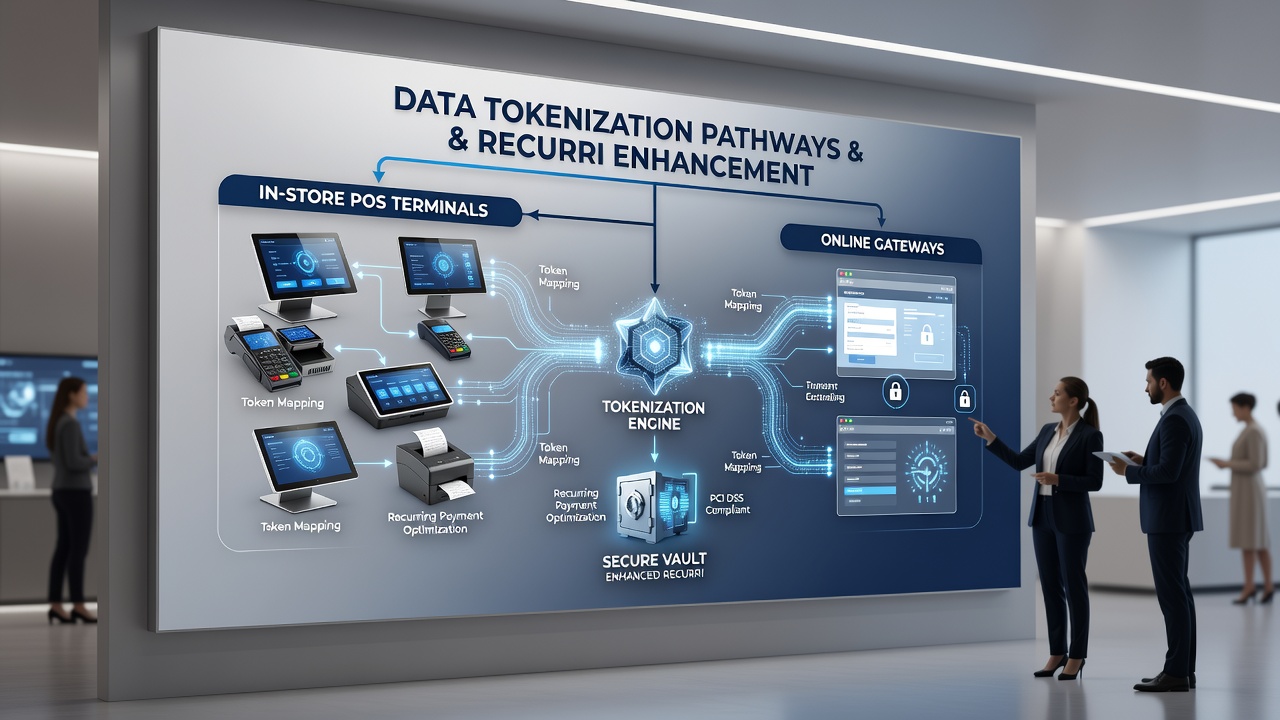
Gateway operators typically route token requests through dedicated services that communicate with card networks, and the resulting tokens enable merchants to initiate subsequent charges without retaining sensitive data locally. Observers note that this architecture supports multi-channel consistency, allowing a token created at a physical terminal to authorize recurring payments initiated through web portals or mobile applications.
Security Advantages for Subscription-Based Revenue Models
Recurring revenue operations face repeated exposure risks during each billing cycle, yet tokenization confines actual card data to secure vaults while tokens handle routine processing. Data from regulatory assessments shows measurable reductions in breach impact when tokenized systems replace stored card numbers, because compromised tokens cannot be reverse-engineered into usable payment credentials. Network token services offered by card brands further strengthen this protection by binding tokens to specific merchants or devices, which limits their utility if intercepted.
Those who operate subscription platforms report that tokenization streamlines compliance audits since the scope of systems requiring PCI validation narrows considerably. Studies conducted by academic institutions have examined how token rotation policies and expiration mechanisms add layers of defense against long-term token compromise in high-volume recurring environments.
Implementation Considerations and Network Standards
Merchants evaluating tokenization solutions must assess interoperability between terminal vendors and gateway providers, because mismatched token formats can disrupt authorization sequences. According to documentation from the National Institute of Standards and Technology, cryptographic key management practices underpin reliable token generation, and organizations must maintain separate key hierarchies for different transaction types to prevent cross-contamination risks. Recurring billing systems benefit when tokens support dynamic updates that accommodate card replacements or expiration events without customer intervention.
Industry analyses highlight that adoption rates have increased as terminal manufacturers embed token services directly into firmware, reducing reliance on external processors for initial conversion steps. Gateway configurations often include fallback procedures that revert to traditional card data handling only under defined exception conditions, preserving security baselines across mixed payment environments.
Conclusion
Tokenization techniques continue to evolve as payment networks refine standards for both physical terminals and digital gateways that support recurring revenue. Organizations that align their systems with these methods gain measurable reductions in data exposure while maintaining operational continuity for subscription billing cycles. Continued collaboration between terminal manufacturers, gateway providers, and standards bodies shapes how these protections scale across diverse merchant operations.