Inside Local Retail Networks: How Support Teams Align Encryption Benchmarks with API Standards for Subscription Charge Cycles on Portable Readers
Rafael Otto · Jul 7, 2026
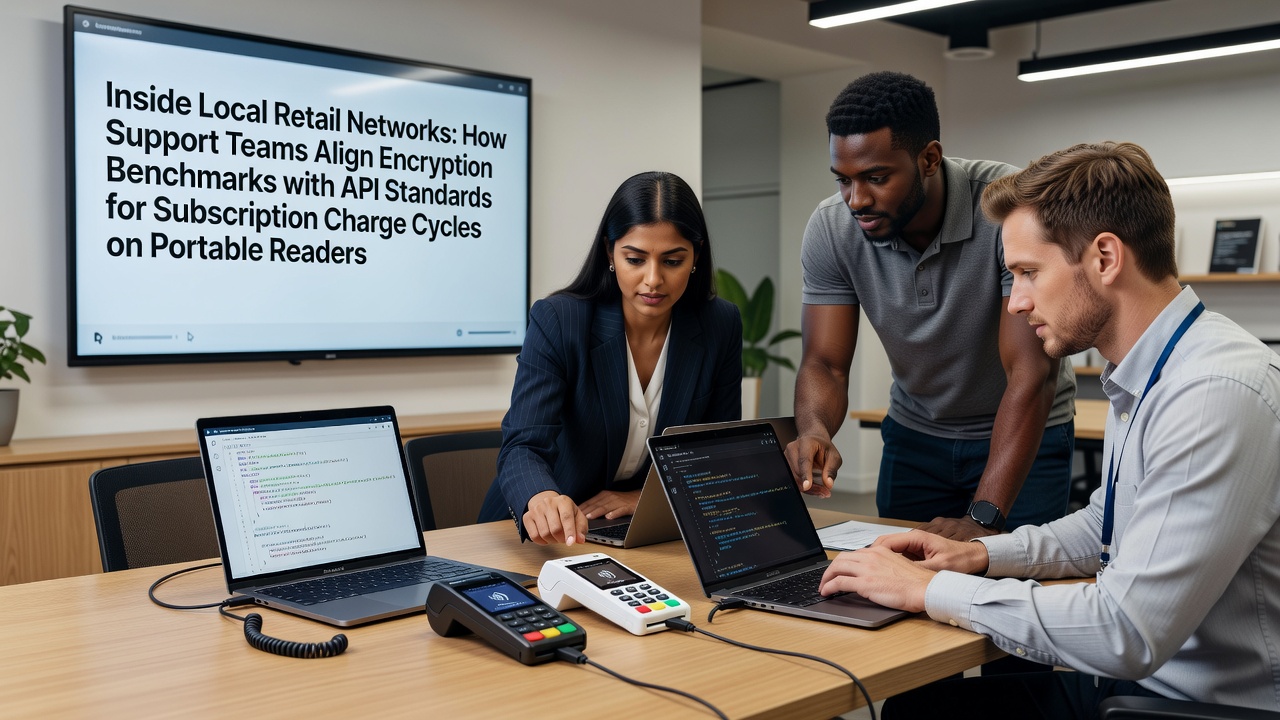
Inside Local Retail Networks: How Support Teams Align Encryption Benchmarks with API Standards for Subscription Charge Cycles on Portable Readers
Local retail networks rely on portable readers to process recurring charges for subscription services, and support teams coordinate the technical requirements that keep these operations compliant. These devices handle data transmission during charge cycles, where encryption benchmarks meet API standards to secure each transaction. Observers note that alignment between these elements reduces exposure points while maintaining seamless operations across independent vendors and small merchants.
Encryption Benchmarks and Their Application in Portable Systems
Encryption benchmarks establish protocols for protecting cardholder data during storage and transmission on mobile terminals. Research from the PCI Security Standards Council indicates that point-to-point encryption combined with tokenization meets baseline requirements for devices handling recurring payments. Support personnel verify that portable readers apply these measures consistently, especially when subscription models trigger automated deductions on set intervals. Data shows that key rotation schedules prevent long-term vulnerabilities, and teams document these processes to satisfy audit trails required under current compliance frameworks.
Portable readers often operate in environments with variable connectivity, which means encryption must function independently of network stability. Teams map data flows from the reader to backend processors, confirming that symmetric and asymmetric methods align with benchmark thresholds. In July 2026, updated guidelines from international bodies emphasize stronger key lengths for devices used in local networks, prompting support groups to reconfigure existing hardware fleets.
API Standards Integration for Recurring Charge Cycles
API standards define how portable readers communicate authorization requests and receive responses during subscription charge cycles. Specifications such as those outlined by the European Payments Council require structured endpoints for recurring transaction identifiers, allowing systems to distinguish one-time payments from scheduled deductions. Support teams configure these integrations so that encryption layers activate before data leaves the device, ensuring the API payload remains protected throughout the cycle. Figures from industry reports reveal that standardized API calls reduce processing latency while preserving security markers across vendor networks.
Alignment occurs when support staff test API responses against encryption outputs, confirming that tokens replace sensitive details before they reach external gateways. This process involves mapping authorization routes where each charge cycle triggers verification steps without exposing raw card data. Those who manage local retail setups find that consistent API versioning helps maintain compatibility when encryption benchmarks receive periodic updates.

Support Team Processes for Maintaining Alignment
Support teams conduct regular audits that compare device firmware against both encryption benchmarks and API documentation. These reviews identify gaps where subscription charge cycles might bypass required security layers. Personnel use diagnostic tools to simulate recurring transactions, tracing data from the portable reader through encrypted channels and into API-authenticated sessions. Evidence suggests that documented workflows allow teams to replicate successful configurations across multiple locations within a retail network.
Training modules delivered to field technicians cover the interplay between encryption key management and API authentication tokens. Sessions emphasize active verification steps rather than passive monitoring, enabling teams to adjust parameters when charge cycle frequencies change. In practice, one network reported that coordinated updates in early 2026 prevented mismatches during peak subscription renewal periods.
Challenges Encountered in Local Retail Environments
Variable device models across local networks create inconsistencies in how encryption benchmarks apply to API calls. Older portable readers may support legacy protocols that require additional middleware to reach current standards, and support teams develop bridging solutions to maintain charge cycle reliability. Geographic factors also influence connectivity, which can affect real-time API confirmations during encrypted transactions.
Subscription models introduce volume-based patterns that stress both encryption resources and API throughput simultaneously. Teams monitor these patterns through centralized dashboards that flag deviations before they impact merchant operations. Reports from Canadian regulatory reviews highlight similar issues in independent retail settings, where alignment efforts focus on scalable configurations rather than one-off fixes.
Conclusion
Support teams in local retail networks perform the coordination required to keep encryption benchmarks synchronized with API standards during subscription charge cycles on portable readers. Through systematic verification, configuration testing, and ongoing adjustments, these groups sustain compliance across diverse device fleets and transaction volumes. Continued reference to evolving specifications ensures that portable systems remain functional while meeting security expectations in July 2026 and beyond.