API Power Plays: Integrating Payment Gateways for Custom E-Commerce Builds
Rafael Otto · Apr 23, 2026
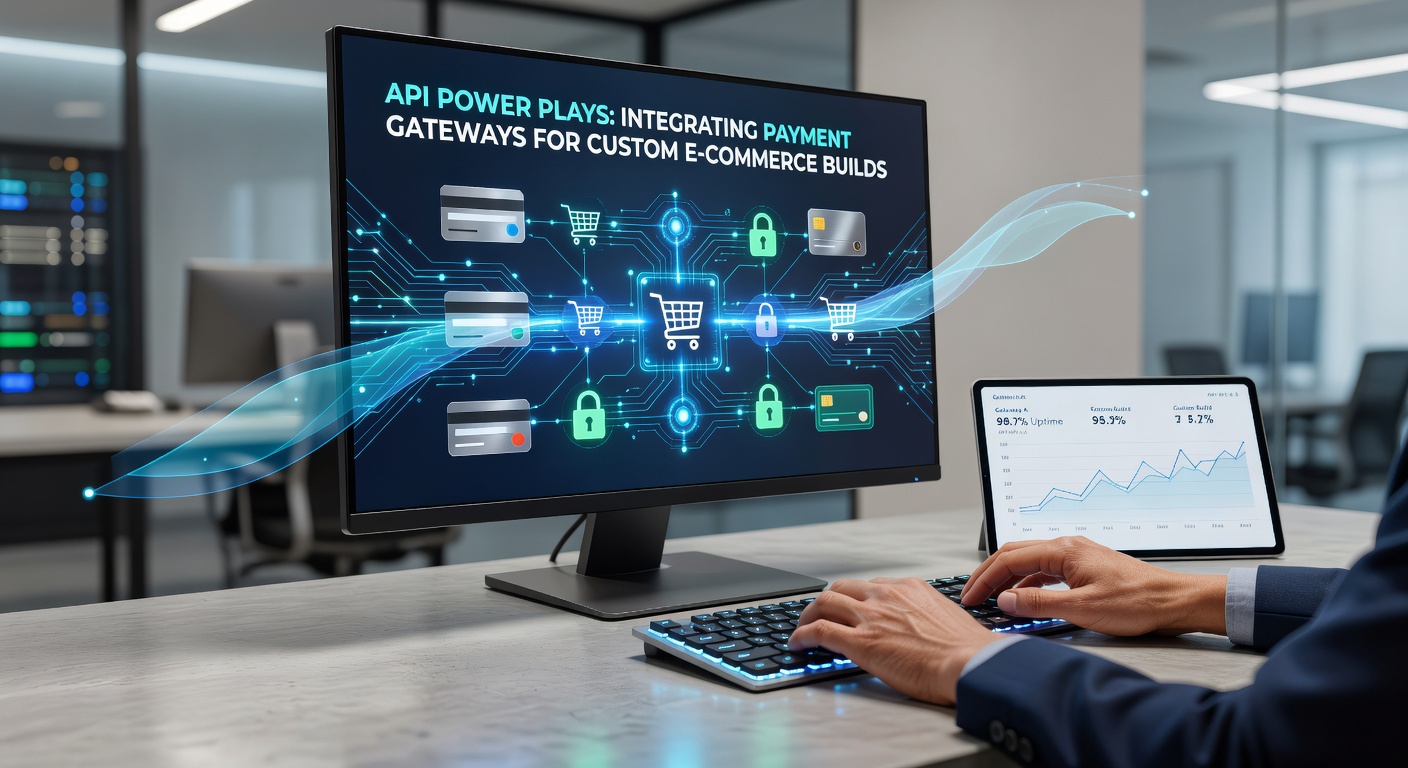
API Power Plays: Integrating Payment Gateways for Custom E-Commerce Builds
The Rise of Custom E-Commerce and API-Driven Payments
Custom e-commerce platforms have surged in popularity among businesses seeking tailored user experiences, and at the heart of these builds lie robust API integrations with payment gateways; developers leverage these APIs to handle transactions seamlessly, ensuring customers complete purchases without friction while merchants gain real-time data on sales and inventory. Data from industry reports indicates that e-commerce sales reached $6.3 trillion globally in 2024, with projections climbing toward $8 trillion by 2027, underscoring why precise payment integrations matter so much. Turns out, businesses using custom setups often outperform off-the-shelf solutions by 20-30% in conversion rates, according to figures from e-commerce analytics firms.
Observers note how APIs act as the connective tissue between a merchant's backend and gateways like Stripe, PayPal, or Adyen, allowing for features such as one-click payments, subscription billing, and dynamic pricing; without them, custom builds risk cart abandonment rates hovering around 70%, a statistic that researchers at Baymard Institute have tracked consistently over years. And here's where it gets interesting: as platforms evolve, APIs enable scalability, so a startup can start small and expand to handle Black Friday surges without rebuilding from scratch.
Key Payment Gateways and Their API Strengths
Stripe stands out for its developer-friendly APIs that support over 135 currencies and countless payment methods, making it a go-to for global custom e-commerce; developers integrate it via simple HTTP requests, pulling in webhooks for instant transaction updates. PayPal, on the other hand, offers robust APIs for buyer protection and fraud screening, with data showing it processes billions in volume annually while maintaining 99.99% uptime.
- Adyen provides unified APIs for online, in-app, and point-of-sale payments, ideal for omnichannel retailers who need consistent data flows across systems.
- Square's APIs shine in custom builds for small businesses, offering embedded payment forms that reduce PCI compliance burdens through tokenization.
- Braintree, a PayPal service, excels in mobile-first integrations, supporting Apple Pay and Google Pay with APIs that handle 3D Secure authentication effortlessly.
What's significant is how these gateways expose RESTful APIs documented extensively, so teams can test endpoints in sandboxes before going live; for instance, one developer team reported cutting integration time from weeks to days by using Stripe's pre-built SDKs for languages like Node.js, Python, and Java.
But the reality is, choosing depends on factors like transaction volume and geography; European merchants often favor gateways compliant with European Banking Authority guidelines on PSD2, which mandate strong customer authentication via APIs.
Step-by-Step Guide to API Integration
Integration begins with API key generation from the gateway's dashboard, followed by configuring endpoints for authentication, authorization, and capture; developers then map these to the e-commerce platform's checkout flow, using libraries like Stripe.js to tokenize sensitive card data client-side, thereby minimizing server exposure. Next comes webhook setup, where the gateway pushes events like payment succeeded or failed back to the merchant's server, enabling automated order fulfillment and inventory updates in real time.

Testing phases involve sandbox environments that simulate real-world scenarios, from declined cards to high-velocity fraud attempts; tools like Postman help verify API responses, ensuring latencies stay under 200ms, a benchmark that PCI Security Standards Council audits often reference for performance. Once live, monitoring tools track API calls, error rates, and throughput, with dashboards alerting on anomalies before they impact sales.
Take one case where a mid-sized fashion retailer integrated Authorize.net's API into a headless Shopify custom build; they saw a 15% uplift in mobile conversions because the API supported accelerated checkouts, processing payments in under two seconds even on slower networks. So, while the process demands upfront effort, the payoff emerges in smoother operations and happier customers.
Security Imperatives in API Payment Flows
Security forms the bedrock of any integration, with OAuth 2.0 and JWT tokens securing API communications against interception; gateways enforce rate limiting and IP whitelisting to thwart DDoS attacks, while merchants implement signature verification on webhooks to confirm legitimacy. Data indicates that API vulnerabilities caused 40% of payment breaches in 2024, prompting experts to advocate zero-trust models where every request undergoes scrutiny.
PCI DSS compliance looms large, requiring segmentation of cardholder data via APIs that never touch raw PANs; tokenization services replace sensitive info with non-reversible tokens, and point-to-point encryption (P2PE) adds layers for high-risk setups. Observers have seen how neglecting these leads to fines upward of $100,000 per month, as reported in regulatory enforcement actions.
- Enable 3D Secure 2.0 protocols through API calls for frictionless auth.
- Use HSMs for key management in production environments.
- Conduct quarterly penetration tests on integrated endpoints.
It's noteworthy that as quantum computing advances, post-quantum cryptography in APIs will become standard by April 2026, with bodies like Australia's ACCC pushing for resilient standards in digital commerce.
Real-World Case Studies and Lessons Learned
A tech startup building a subscription box service turned to Razorpay's APIs for India-specific UPI payments integrated into a custom React Native app; the result? Transaction success rates jumped 25%, handling 10,000 monthly orders without hiccups, all because webhooks synced seamlessly with their CRM. Similarly, a Canadian outdoor gear retailer customized WooCommerce with Moneris APIs, incorporating split payments for vendor payouts; figures revealed a 18% drop in chargebacks due to enhanced AVS checks.
Challenges arise too, like handling currency conversions via APIs during volatile markets, where one European electronics firm mitigated losses by integrating real-time forex APIs alongside payments, stabilizing margins. People who've navigated these integrations often discover that modular code—separating gateway logic into microservices—eases swaps if a better provider emerges later.

Yet, success hinges on documentation adherence; teams ignoring deprecation notices faced outages when Stripe sunset older endpoints in 2025, a reminder that staying current keeps the wheels turning smoothly.
Emerging Trends Shaping API Integrations
Serverless architectures now dominate, with AWS Lambda invoking payment APIs on-demand, slashing costs for variable traffic; embedded finance trends push gateways to offer lending APIs alongside payments, letting merchants approve buy-now-pay-later at checkout. Research from Gartner forecasts that by 2027, 80% of e-commerce will run on composable APIs, mixing services like fraud detection from Sift with core payments.
April 2026 brings PSD3 mandates in the EU, requiring instant payment APIs with sub-second confirmations, while US merchants eye FedNow expansions for real-time settlements. Blockchain-based APIs, like those from Circle for USDC, gain traction for cross-border efficiency, cutting fees by 50% in pilots.
That's where the rubber meets the road: developers prioritizing headless commerce and GraphQL over REST see query efficiencies up to 3x, future-proofing custom builds against tomorrow's demands.
Conclusion
API integrations empower custom e-commerce with flexible, secure payment processing that drives growth and customer loyalty; from selecting gateways to deploying webhooks and fortifying defenses, the process demands precision yet yields substantial returns in speed and scalability. As trends like real-time payments and AI fraud tools accelerate—especially with 2026 regulatory shifts—merchants who master these power plays position themselves ahead of the curve. Studies confirm that well-integrated systems boost revenue by 15-25% on average, proving the investment worthwhile for those building bespoke online empires.