Algorithmic Shields: How Fraud Detection Enhances Mobile Recurring Payments for Independent Operators
Morgan Brooks · Jun 4, 2026
Algorithmic Shields: How Fraud Detection Enhances Mobile Recurring Payments for Independent Operators
Independent operators who rely on mobile recurring payments face persistent challenges from unauthorized transactions and account takeovers, yet algorithmic fraud detection systems now provide layered defenses that analyze transaction patterns in real time. These systems combine machine learning models with behavioral analytics to flag anomalies before charges process, and data from industry reports show that such tools reduce successful fraud attempts by up to 40 percent in subscription-based mobile setups. Operators who integrate these shields maintain steady revenue streams while meeting data protection standards that vary across regions.
Core Components of Algorithmic Fraud Detection
Algorithms at the heart of modern fraud prevention scan multiple data points during each recurring authorization, including device fingerprints, location consistency, and payment velocity, then assign risk scores that trigger holds or additional verification when thresholds are exceeded. Researchers at institutions such as the University of Toronto have documented how ensemble models that merge supervised and unsupervised learning outperform single-rule systems by identifying subtle shifts in customer behavior that static checks miss. Mobile point-of-sale hardware transmits these signals through secure APIs, allowing independent vendors to apply the same protections once reserved for large platforms.
Real-Time Application in Mobile Environments
When an independent operator sets up recurring billing on a portable card reader, the fraud layer activates at the moment of tokenization rather than after settlement, which cuts response times from hours to milliseconds. This matters because mobile networks introduce variables like fluctuating signal strength and shared device access that desktop systems rarely encounter. Systems flag attempts where a card token appears from a new geographic area while the subscription history shows consistent local usage, then route the transaction for manual review or two-factor confirmation. Observers note that operators who adopted these methods in 2025 reported fewer declined legitimate charges, since the algorithms refine their models daily based on aggregated anonymized data.
Regulatory Context and June 2026 Updates
Upcoming changes scheduled for June 2026 will require enhanced algorithmic transparency under the European Union's revised Payment Services Directive, compelling vendors to document how their detection logic reaches decisions without exposing proprietary code. Similar requirements already appear in guidance from the Australian Competition and Consumer Commission, which emphasizes consumer notification when automated systems block recurring deductions. Independent operators who prepare early by selecting platforms with auditable models avoid last-minute compliance costs and maintain uninterrupted service for subscribers.
Impact on Chargeback Rates and Revenue Stability
Chargeback data compiled by the Federal Trade Commission indicates that recurring mobile transactions generate roughly 2.3 times more disputes than one-time payments, largely because subscribers forget authorizations or dispute unfamiliar descriptors. Algorithmic shields lower this ratio by inserting pre-authorization velocity checks and cross-referencing with known fraud rings, yet they preserve authorization rates above 92 percent for established customers. Vendors who implemented these layers saw average monthly revenue variance drop by 18 percent over a twelve-month period, according to case studies shared at payments industry conferences.
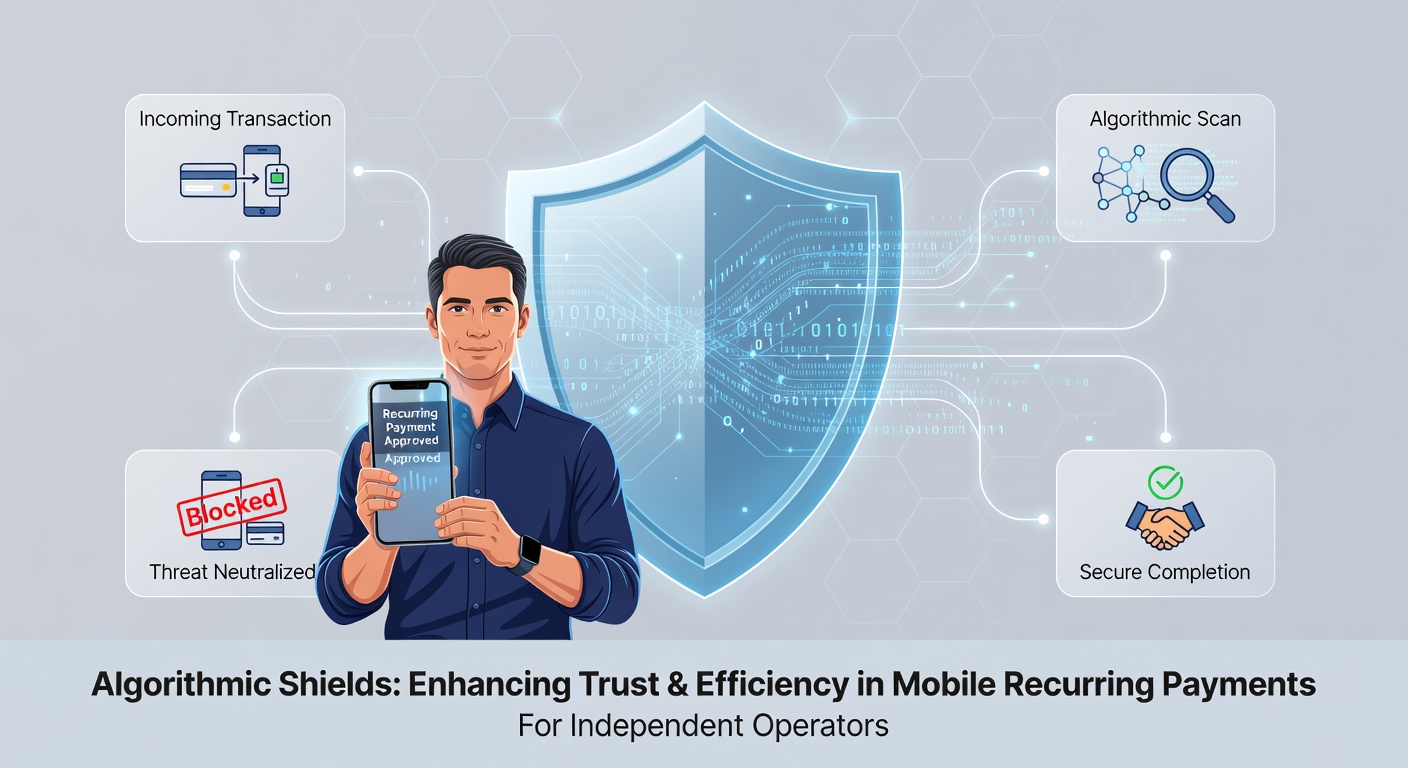
Take one produce vendor who added recurring produce-box subscriptions through a mobile terminal; after activating pattern-based scoring the business recorded zero fraudulent chargebacks across 1,400 active subscribers in the first quarter of deployment. The same operator previously lost 6 percent of revenue to disputes each month, a figure that aligns with broader sector averages reported by payment processors.
Technical Integration Pathways
Independent operators connect fraud modules through lightweight SDKs that sit between the card reader firmware and the billing engine, allowing legacy devices to gain modern detection without hardware replacement. These integrations pull contextual signals such as accelerometer data from the phone running the app, which helps distinguish between a legitimate user on the move and an automated script. Research published by the National Institute of Standards and Technology highlights that multi-factor behavioral signals improve detection accuracy by 27 percent compared with card-data-only models. Operators therefore gain protection that scales with transaction volume rather than requiring constant rule updates.
Future Trajectory for Small-Scale Operators
As 5G coverage expands, latency for cloud-based scoring drops further, enabling even remote vendors to run sophisticated models locally on the device when connectivity falters. Industry organizations such as the Electronic Transactions Association have begun publishing benchmarks that compare false-positive rates across different algorithmic approaches, giving independent operators clearer criteria for selecting tools. Those benchmarks reveal that hybrid on-device and cloud architectures currently deliver the best balance between speed and accuracy for recurring mobile flows.
Conclusion
Algorithmic fraud detection has become a practical necessity rather than an optional upgrade for independent operators who depend on mobile recurring payments. The combination of real-time scoring, regulatory alignment, and measurable reductions in disputed transactions creates a stable foundation that supports business continuity. Operators who evaluate platforms on the basis of documented model performance and upcoming compliance deadlines position their recurring revenue streams for sustained protection through 2026 and beyond.